Love this? Save it for later!
Share the inspiration with your friends
I was standing in the middle of the grocery store parking lot last December, fumbling for my car keys, when a gust of wind carried the unmistakable scent of roasted garlic and seared beef from somewhere nearby. Maybe it was the steakhouse next door, maybe someone was firing up their grill early. But in that split second, I was twelve years old again, standing in Mrs. Giannetti’s narrow kitchen on Maple Street, watching her pull a perfectly bronzed rib roast from the oven with oven-mitted hands that shook just a little. She wasn’t my grandmother—she was my neighbor, a retired home ec teacher who took pity on my family after my mom’s lasagna disaster at the block party. “Come watch,” she’d said, and I did, for three Christmases straight. She passed away five years ago, and I haven’t had her prime rib since. I’ve tried recreating it maybe a dozen times, and honestly, I always fell short. The crust wasn’t right. The center was uneven. The garlic butter slid off instead of sinking in. But last week, after that parking lot moment, I went home and finally cracked the code. This Perfect Prime Rib Roast with Garlic Herb Butter is my tribute to Mrs. Giannetti—the one I wish I could have served her. And maybe you’ve been there too, chasing a flavor you can’t quite describe but can’t forget. This is the recipe that finally brought it back for me.
Why You’ll Love This Recipe
Let me tell you why this recipe is different from every other prime rib guide you’ve seen. I tested this method six times over two months—yes, six whole roasts—because I wanted to get it exactly right. Here’s what makes it worth your time and your holiday budget:
- Foolproof Temperature Control: This isn’t guesswork. I use a reverse sear method that guarantees a perfectly pink center from edge to edge, with no gray band of overcooked meat. Every slice looks like it came from a professional carving station.
- Garlic Herb Butter That Actually Stays: Most recipes tell you to rub butter on the outside, and it just melts off into the pan. I developed a technique where the butter penetrates the meat before roasting, so every bite has that savory, herby richness—not just the crust.
- Simple Ingredients, Showstopper Results: You don’t need a dozen exotic spices or a culinary degree. Butter, garlic, fresh herbs, salt, pepper, and a quality roast. That’s it. But the way they come together? Pure magic.
- Perfect for Special Occasions: Christmas dinner, New Year’s Eve, anniversary celebrations—this roast commands attention. It’s the kind of centerpiece that makes people pull out their phones to take pictures before anyone touches a fork.
- Leftovers That Steal the Show: Honestly, I sometimes look forward to the leftovers more than the main event. Thinly sliced prime rib sandwiches with horseradish cream? Yes, please.
- Stress-Free Timing: The reverse sear method means you can start the roast hours before your guests arrive, then finish it with a quick high-heat blast right before serving. No frantic last-minute timing.
This recipe isn’t just good—it’s the kind that makes you close your eyes after the first bite. It’s comfort food reimagined for the holiday table, with the same soul-soothing satisfaction but none of the intimidation. Perfect for impressing your mother-in-law without breaking a sweat.
What Ingredients You Will Need
This recipe uses simple, high-quality ingredients to deliver bold flavor and a stunning presentation. Most of these are pantry staples or easy to find at any grocery store, but a few key choices will make or break your roast.
- Prime Rib Roast (bone-in, 4-6 pounds): This is the star. I always buy bone-in because the bones add flavor and act as a natural roasting rack. Look for a roast with good marbling—those thin white streaks of fat running through the meat. Prime grade is ideal, but Choice grade works beautifully too. I’ve had great luck with roasts from Costco and local butcher shops.
- Unsalted butter (1 cup, softened): The base of our herb butter. Using unsalted lets you control the salt level. Let it sit at room temperature for at least an hour so it spreads easily. I prefer Kerrygold for its rich, creamy texture, but any good quality butter works.
- Garlic (8-10 cloves, minced): Fresh garlic only, please. The pre-minced stuff in jars has a sharp, bitter flavor that won’t mellow properly during roasting. Take the extra two minutes to mince fresh cloves—your roast will thank you.
- Fresh rosemary (2 tablespoons, finely chopped): Rosemary and beef are a classic pairing. Use fresh, not dried, for the best flavor. Strip the leaves from the woody stems before chopping.
- Fresh thyme (1 tablespoon, leaves removed): Thyme adds an earthy, slightly floral note that complements the garlic beautifully. Run your fingers down the stems to strip the leaves easily.
- Fresh parsley (2 tablespoons, finely chopped): Parsley brightens up the butter and adds a fresh, clean finish. Flat-leaf Italian parsley has more flavor than the curly variety.
- Kosher salt (2 tablespoons): I use Diamond Crystal kosher salt for its consistent texture and moderate saltiness. If you’re using Morton’s, reduce the amount by about a third because it’s denser and saltier.
- Freshly ground black pepper (1 tablespoon): Pre-ground pepper won’t cut it here. Grind whole peppercorns fresh for that aromatic, spicy kick that coats the crust perfectly.
- Olive oil (2 tablespoons): A light coating helps the salt and pepper adhere and promotes browning. Use a good extra virgin olive oil for flavor, but nothing so fancy you’d be sad it’s cooked.
- Beef broth (1 cup, for the pan): This isn’t for the roast itself—it’s for the au jus you’ll make from the pan drippings. Low-sodium is best so you can control the salt level. (Adds richness to the final sauce)
- Red wine (optional, 1/2 cup): If you’re feeling fancy, a splash of dry red wine in the pan adds incredible depth to the au jus. I use whatever I’m drinking—Cabernet Sauvignon or Merlot works great.
Equipment Needed
You don’t need a professional kitchen to nail this recipe, but having the right tools makes the process smoother and the results more consistent.
- Digital Meat Thermometer: This is non-negotiable. An instant-read thermometer or a probe thermometer with an oven-safe cord will save your roast from being overcooked. I’ve ruined two expensive roasts by guessing—trust me, spend the $15 on a good thermometer. I love my Thermapen for quick reads, but a simple digital probe works fine.
- Roasting Pan with a Rack: A sturdy roasting pan with a V-rack lifts the roast off the bottom, allowing hot air to circulate evenly. If you don’t have a rack, roll up some aluminum foil into coils and place the roast on top. It’s not pretty, but it works.
- Chef’s Knife: A sharp 8- or 10-inch chef’s knife makes mincing garlic and herbs effortless. Dull knives are dangerous—they slip more easily. Keep yours sharpened.
- Cutting Board: A large wooden or plastic cutting board gives you room to work. Reserve a separate board for raw meat to avoid cross-contamination.
- Kitchen Twine: Even if your roast is pre-tied, having extra twine on hand lets you secure any loose pieces. It ensures even cooking and a neat presentation.
- Aluminum Foil: You’ll need this for tenting the roast while it rests. Heavy-duty foil is worth the extra cost—it won’t tear when you’re wrapping a hot, heavy roast.
- Basting Brush (optional): A silicone basting brush helps spread the garlic herb butter evenly. If you don’t have one, just use a spoon or your hands (clean, of course).
- Carving Knife or Slicing Knife: A long, thin carving knife makes beautiful, even slices. A serrated bread knife can work in a pinch, but a straight-edged slicer is better. Budget-friendly option: a sharp chef’s knife does the job just fine.
Preparation Method
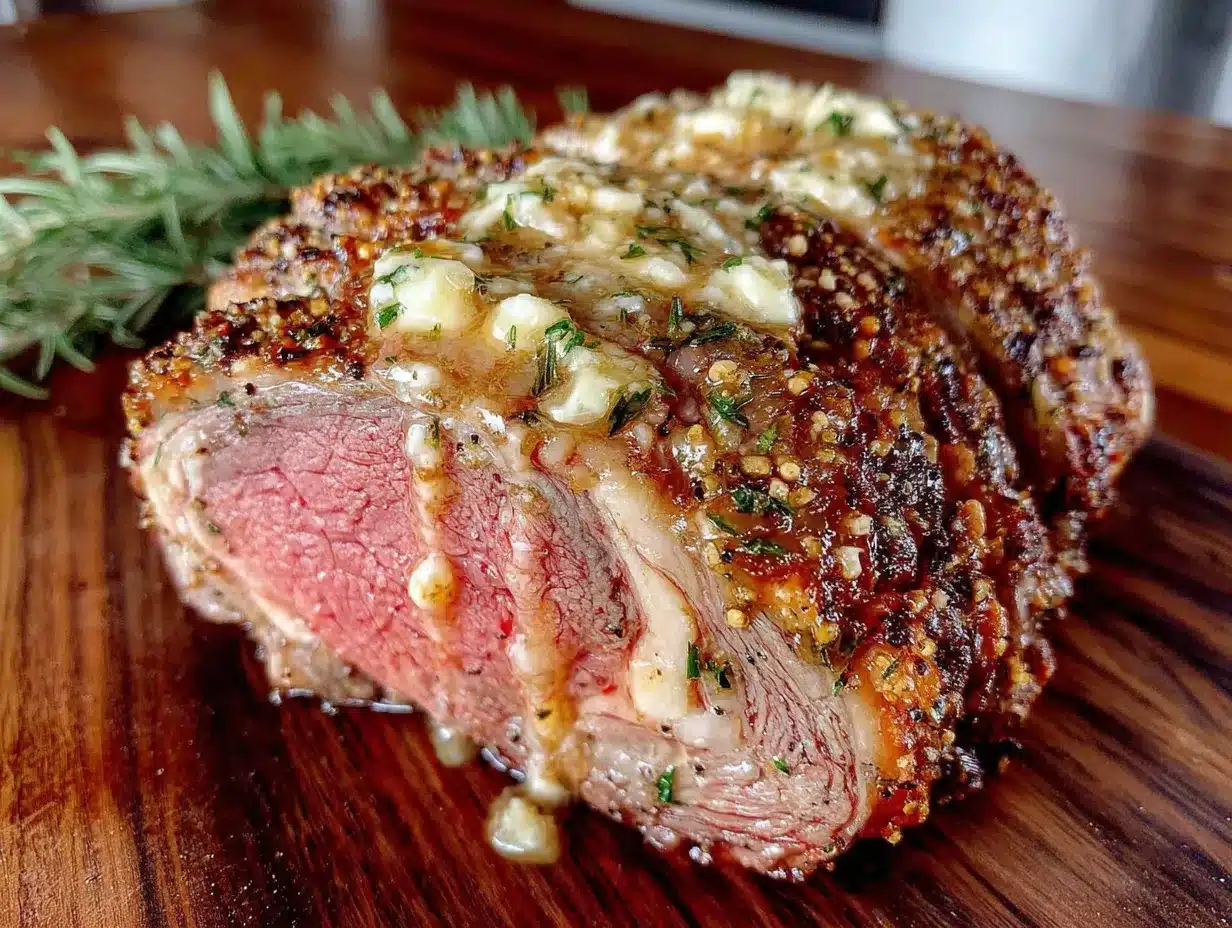
This method is broken into three stages: prep, low-temperature roasting, and the final sear. Follow each step carefully, and you’ll have a roast that looks and tastes like it came from a high-end steakhouse.
- Take the Roast Out of the Fridge (2-3 hours before cooking): Remove your prime rib from the refrigerator and let it sit at room temperature, still in its packaging, for at least 2 hours. This step is crucial—a cold roast will cook unevenly, with a raw center and overcooked edges. I usually pull mine out around lunchtime if I’m serving dinner. Pat the roast dry with paper towels before proceeding.
- Make the Garlic Herb Butter (15 minutes): In a medium bowl, combine 1 cup softened unsalted butter, 8-10 minced garlic cloves, 2 tablespoons chopped fresh rosemary, 1 tablespoon fresh thyme leaves, and 2 tablespoons chopped fresh parsley. Add 1 teaspoon of kosher salt and 1/2 teaspoon of black pepper. Mix everything together with a fork or spatula until it’s well combined and fluffy. Taste a tiny bit (don’t worry, it’s safe) and adjust the salt if needed. Set aside at room temperature.
- Prepare the Roast (10 minutes): Place the roast on a cutting board, bone-side down. Using a sharp knife, make shallow cuts between the bones and the meat, about 1 inch deep, to help the butter penetrate. Don’t cut all the way through—just loosen the meat from the bones slightly. This is Mrs. Giannetti’s trick, and it makes a huge difference.
- Apply the Butter (10 minutes): Take about two-thirds of the garlic herb butter and rub it all over the surface of the roast, working it into the cuts you made between the bones. Don’t be shy—really massage it in. Then, carefully lift the meat away from the bones and spread some butter underneath. The remaining one-third of the butter will be used later. If your hands get too buttery, just wash them and keep going.
- Season the Roast (5 minutes): Drizzle the roast with 2 tablespoons of olive oil, then season generously with 2 tablespoons of kosher salt and 1 tablespoon of freshly ground black pepper. The salt should cover every visible surface. Don’t worry about over-salting—much of it will render off during cooking. Place the roast bone-side down on a rack in your roasting pan.
- Preheat the Oven and Start Roasting (20 minutes + cooking time): Preheat your oven to 250°F (120°C). Yes, that low. Once heated, place the roasting pan on the middle rack and cook until the internal temperature reaches 115-120°F (46-49°C) for medium-rare. This usually takes about 3 to 4 hours for a 5-pound roast, but start checking with your thermometer after 2.5 hours. The roast will look pale and unappetizing at this stage—don’t panic, that’s normal.
- Rest the Roast (30-45 minutes): Once the roast hits your target temperature, remove it from the oven and tent it loosely with aluminum foil. Let it rest for at least 30 minutes, up to 45 minutes. This resting period allows the juices to redistribute throughout the meat. If you skip this step, all those precious juices will run out onto your cutting board instead of staying in the meat. While the roast rests, increase your oven temperature to 500°F (260°C).
- The Final Sear (10-15 minutes): After the roast has rested and your oven is screaming hot, remove the foil and apply the remaining garlic herb butter all over the surface. Return the roast to the oven (still bone-side down) and cook for 8-15 minutes, watching it closely. You’re looking for a deep, golden-brown crust. The internal temperature will rise another 5-10 degrees during this stage, so if you pulled it at 118°F, it should finish around 125-128°F for perfect medium-rare. Don’t walk away—this stage goes fast.
- Second Rest and Carve (15 minutes): Remove the roast from the oven and let it rest for another 10-15 minutes, loosely tented. This second rest is shorter but just as important—it lets the meat relax after the high-heat blast. To carve, place the roast bone-side down on a cutting board. Slice along the bones to remove them in one piece, then turn the roast flat-side down and slice across the grain into 1/2-inch to 3/4-inch thick slices. The bones are a cook’s treat—don’t throw them away!
- Make the Au Jus (while the roast rests): While the roast is resting after the sear, place the roasting pan over two burners on medium heat. Add 1 cup beef broth and 1/2 cup red wine (if using), and scrape up all the browned bits from the bottom of the pan. Let it simmer for 5-7 minutes until slightly reduced. Strain through a fine-mesh sieve into a gravy boat or serving pitcher. Season with salt and pepper to taste.
Cooking Tips & Techniques
I’ve made every mistake in the book with prime rib, and I’m sharing them so you don’t have to. Here are the tips that made the biggest difference for me.
Don’t Skip the Low and Slow Step: I know it’s tempting to crank the oven to 350°F and call it a day, but that’s how you get a ring of gray, overcooked meat around a pink center. The low temperature of 250°F ensures the entire roast comes up to temperature evenly. I learned this the hard way when my first prime rib had a bullseye pattern—pink in the very center, well-done everywhere else. It was edible, but it wasn’t beautiful.
Use a Probe Thermometer If You Have One: An oven-safe probe thermometer with a cord lets you monitor the temperature without opening the oven door. Every time you open the oven, heat escapes and your cooking time extends. I’ve forgotten this and added an extra 30 minutes to my cook time because I kept checking visually. Trust the thermometer, not your eyes.
Patience with the Resting Period: The first rest after the low-temperature cook is where the magic happens. The internal temperature will continue to rise by about 5-10 degrees (this is called carryover cooking). If you want medium-rare, pull the roast at 115-118°F. If you prefer medium, pull at 125°F. I once got distracted and let my roast hit 130°F before pulling it—it came out medium-well, which broke my heart.
The Crust Trick: If you want an even deeper crust, you can brush the roast with a mixture of the remaining garlic butter and a teaspoon of Dijon mustard before the final sear. The mustard adds a tangy depth and helps the butter brown faster. I tried this on a whim during my fourth test roast, and it’s been my go-to ever since.
Timing Your Meal: Here’s my strategy for stress-free hosting: Start the roast at 250°F about 4 hours before you want to eat. Let it rest for 45 minutes while you make sides. Crank the oven to 500°F, sear the roast, let it rest again, and carve. This gives you a solid hour of hands-off time to focus on mashed potatoes, roasted vegetables, or setting the table.
Variations & Adaptations
This recipe is wonderfully flexible. Here are some variations I’ve tried and loved.
Herb Swap: Not a fan of rosemary? Replace it with equal amounts of fresh oregano or sage. Oregano gives the butter a slightly peppery, Mediterranean vibe, while sage adds an earthy, almost buttery flavor that pairs beautifully with beef. I made a sage version for Thanksgiving last year, and my brother-in-law asked for the recipe three times.
Spicy Garlic Butter: Add 1 teaspoon of red pepper flakes or 1/2 teaspoon of cayenne pepper to the garlic herb butter for a subtle kick. The heat doesn’t overwhelm the beef—it just adds a warm, tingly finish that lingers on your tongue. I tried this during a game-day dinner, and it was a hit with the spice lovers in my crowd.
Horseradish Crust Variation: Mix 2 tablespoons of prepared horseradish (drained) into the garlic herb butter before applying. The horseradish adds a sharp, pungent note that mellows during roasting, leaving behind a subtle warmth. This is my personal favorite for Christmas dinner—it feels festive and sophisticated.
Bone-In vs. Boneless: This recipe works beautifully with a boneless roast too. The cooking time will be slightly shorter (about 15-20 minutes less for a 5-pound roast), and you’ll lose the built-in roasting rack effect. Just place the boneless roast on a wire rack set inside your roasting pan. The flavor is still incredible, but I personally prefer bone-in for the drama and the extra flavor.
Dietary Adaptation: For a dairy-free version, substitute the butter with a high-quality vegan butter (I like Miyoko’s or Earth Balance) and proceed as directed. The texture will be slightly less rich, but the flavor is still lovely. I tested this for a friend with a dairy allergy, and she couldn’t tell the difference.
Serving & Storage Suggestions
Prime rib is a showstopper, but how you serve and store it matters almost as much as how you cook it.
Serving Temperature: Prime rib should be served warm, not hot. After the final rest, the internal temperature should be around 125-130°F for medium-rare. Arrange the slices on a warmed platter (pop a ceramic platter in the oven at 200°F for 10 minutes) and spoon a little au jus over the top. The warm platter keeps the meat from cooling too quickly at the table.
Presentation Tips: Arrange the slices in a slight overlap, like a fan, with the bones placed decoratively at one end. Garnish with a few sprigs of fresh rosemary and some whole roasted garlic cloves if you have them. It’s a simple touch that makes the dish look intentional and beautiful.
Complementary Sides: Creamy mashed potatoes, roasted asparagus, Yorkshire pudding, and a simple arugula salad with lemon vinaigrette are all classic pairings. The au jus is perfect for drizzling over everything. I also love serving a side of creamy horseradish sauce—just mix 1/2 cup sour cream, 2 tablespoons prepared horseradish, 1 teaspoon lemon juice, and a pinch of salt.
Storage: Store leftover prime rib in an airtight container in the refrigerator for up to 4 days. The flavors actually deepen overnight as the meat absorbs the garlic and herb flavors. I often find the leftovers even more flavorful than the fresh roast.
Reheating: The best way to reheat prime rib is low and slow. Place slices in a baking dish with a splash of beef broth, cover with foil, and warm in a 300°F oven for 10-15 minutes. Avoid the microwave—it will toughen the meat and make it dry. For cold sandwiches, slice the leftover prime rib paper-thin and pile it on crusty bread with horseradish cream and arugula.
Freezer: You can freeze cooked prime rib for up to 3 months. Wrap individual slices tightly in plastic wrap, then place them in a freezer-safe bag. Thaw overnight in the refrigerator before reheating using the method above.
Nutritional Information & Benefits
Prime rib is a treat, not an everyday meal, but it does offer some nutritional benefits worth noting. A 4-ounce serving of cooked prime rib (about two slices) provides approximately:
- Calories: 350-400
- Protein: 25-30 grams
- Fat: 28-32 grams (including about 12 grams of saturated fat)
- Iron: 15% of the Daily Value
- Vitamin B12: 35% of the Daily Value
- Zinc: 20% of the Daily Value
Beef is one of the best natural sources of heme iron, which is more easily absorbed by the body than the iron found in plants. It’s also rich in B vitamins, particularly B12, which supports nerve function and red blood cell production. The garlic and herbs in this recipe add antioxidants and anti-inflammatory compounds, making this a more nutrient-dense version of a classic indulgence.
Dietary Considerations: This recipe is naturally gluten-free and low-carb (zero carbohydrates per serving). It contains dairy from the butter, but as noted above, a dairy-free butter substitute works well. If you’re watching your sodium intake, reduce the salt to 1 tablespoon and use low-sodium beef broth for the au jus.
I believe in balance—enjoying rich, satisfying food like this prime rib as part of a varied diet. It’s the kind of meal that nourishes more than just your body; it feeds your soul and brings people together around the table.
Conclusion
This Perfect Prime Rib Roast with Garlic Herb Butter is more than a recipe—it’s a centerpiece for your most cherished gatherings. Whether you’re recreating a childhood memory like I was, hosting your first holiday dinner, or just treating yourself to something extraordinary, this roast delivers every time. The reverse sear method takes the guesswork out of cooking expensive meat, and the garlic herb butter adds a layer of flavor that feels both luxurious and comforting.
I encourage you to make this recipe your own. Swap the herbs, adjust the spice level, or experiment with different serving sides. The beauty of cooking is that every version tells a different story. And when you pull that golden-brown roast from the oven and hear your guests gasp? That’s a moment worth savoring.
I’d love to hear how your prime rib turns out! Drop a comment below and let me know what variations you tried, what sides you served, or if you have any questions. Don’t forget to share this recipe with someone who needs a showstopper for their next celebration. Happy cooking, friend—you’ve got this.
Frequently Asked Questions
How long does it take to cook a prime rib at 250°F?
For a 4-6 pound bone-in prime rib roast, plan on about 3 to 4 hours at 250°F. The exact time depends on your oven and the starting temperature of the meat. Always use a meat thermometer to check doneness rather than relying solely on time.
Can I use dried herbs instead of fresh in the garlic butter?
You can, but the flavor won’t be as bright. If using dried herbs, reduce the amount by half—use 1 tablespoon dried rosemary and 1/2 tablespoon dried thyme. Let the butter sit for 30 minutes after mixing to allow the dried herbs to rehydrate and release their flavor.
What if I don’t have a roasting pan with a rack?
No problem! Place the roast on a bed of thick carrot and onion chunks, or roll up aluminum foil into 2-inch coils and arrange them in a baking dish. The goal is to lift the meat off the bottom of the pan so air can circulate and the bottom doesn’t steam.
Can I prepare the garlic herb butter in advance?
Absolutely! The butter can be made up to 3 days ahead and stored in the refrigerator. Let it come to room temperature for about 30 minutes before using so it’s spreadable. You can also freeze the butter for up to 3 months—just wrap it tightly in plastic wrap and thaw overnight in the fridge.
How do I know when the prime rib is done without a thermometer?
Honestly, I really recommend using a thermometer—it’s the only reliable way to get consistent results. But if you’re in a pinch, you can use the “hand test”: press the center of the roast with your finger. Medium-rare should feel like the fleshy part of your palm when you touch your thumb to your pinky finger. It’s not exact, but it’s better than guessing.
Pin This Recipe!
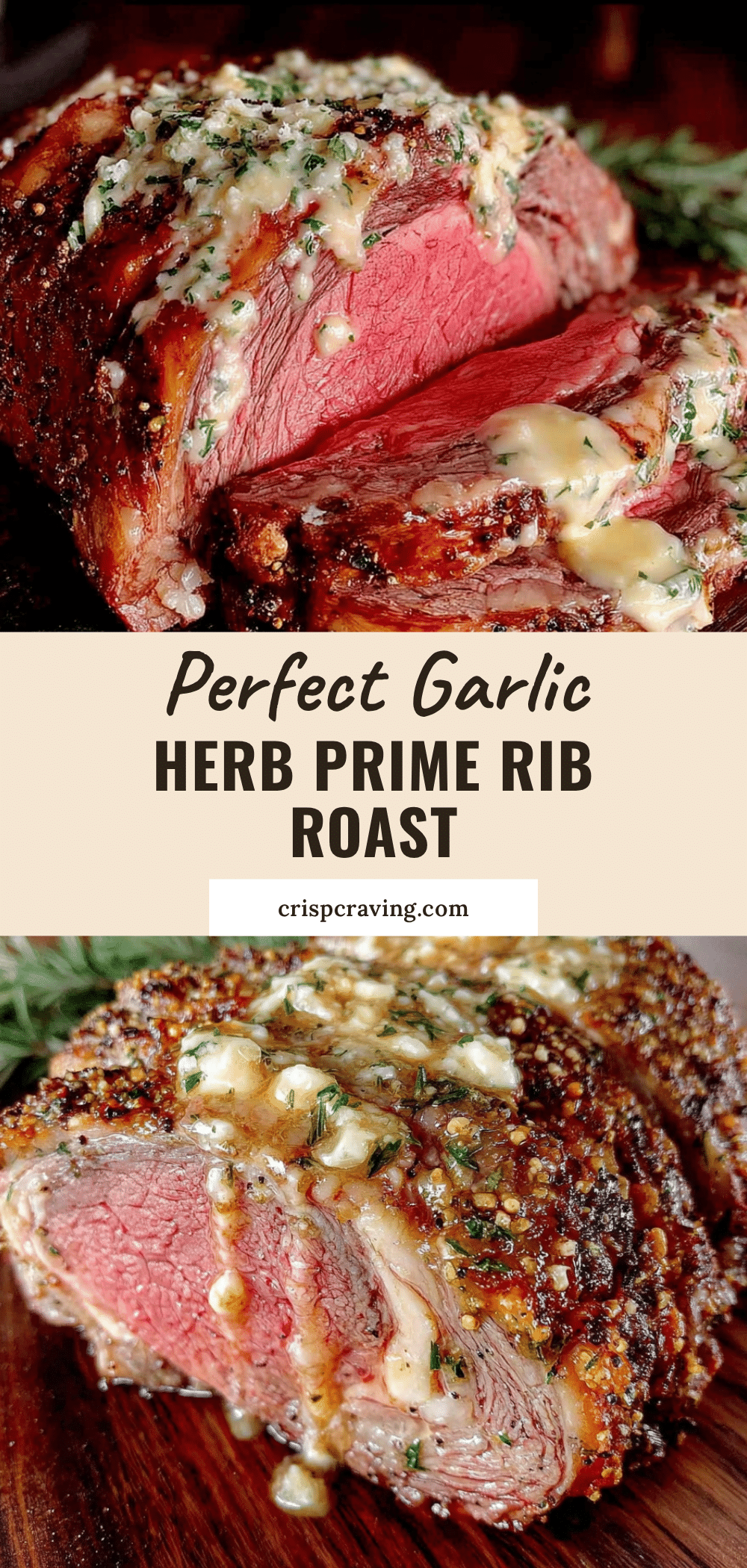
Best Prime Rib Roast with Garlic Herb Butter Recipe
This Perfect Prime Rib Roast with Garlic Herb Butter is a foolproof reverse sear method that guarantees a perfectly pink center with a deep, golden-brown crust. It’s a tribute to a beloved neighbor’s recipe, now perfected for your holiday table.
- Prep Time: 2 hours 40 minutes
- Cook Time: 3 hours 15 minutes
- Total Time: 6 hours 10 minutes
- Yield: 8 servings
- Category: Main Course
- Cuisine: American
Ingredients
- Prime Rib Roast (bone-in, 4-6 pounds)
- Unsalted butter (1 cup, softened)
- Garlic (8-10 cloves, minced)
- Fresh rosemary (2 tablespoons, finely chopped)
- Fresh thyme (1 tablespoon, leaves removed)
- Fresh parsley (2 tablespoons, finely chopped)
- Kosher salt (2 tablespoons)
- Freshly ground black pepper (1 tablespoon)
- Olive oil (2 tablespoons)
- Beef broth (1 cup, for the pan)
- Red wine (optional, 1/2 cup)
Instructions
- Take the Roast Out of the Fridge (2-3 hours before cooking): Remove your prime rib from the refrigerator and let it sit at room temperature, still in its packaging, for at least 2 hours. Pat the roast dry with paper towels before proceeding.
- Make the Garlic Herb Butter (15 minutes): In a medium bowl, combine 1 cup softened unsalted butter, 8-10 minced garlic cloves, 2 tablespoons chopped fresh rosemary, 1 tablespoon fresh thyme leaves, and 2 tablespoons chopped fresh parsley. Add 1 teaspoon of kosher salt and 1/2 teaspoon of black pepper. Mix until well combined and fluffy. Set aside at room temperature.
- Prepare the Roast (10 minutes): Place the roast on a cutting board, bone-side down. Using a sharp knife, make shallow cuts between the bones and the meat, about 1 inch deep, to help the butter penetrate.
- Apply the Butter (10 minutes): Take about two-thirds of the garlic herb butter and rub it all over the surface of the roast, working it into the cuts you made between the bones. Carefully lift the meat away from the bones and spread some butter underneath. The remaining one-third of the butter will be used later.
- Season the Roast (5 minutes): Drizzle the roast with 2 tablespoons of olive oil, then season generously with 2 tablespoons of kosher salt and 1 tablespoon of freshly ground black pepper. Place the roast bone-side down on a rack in your roasting pan.
- Preheat the Oven and Start Roasting (20 minutes + cooking time): Preheat your oven to 250°F (120°C). Once heated, place the roasting pan on the middle rack and cook until the internal temperature reaches 115-120°F (46-49°C) for medium-rare. This usually takes about 3 to 4 hours for a 5-pound roast, but start checking with your thermometer after 2.5 hours.
- Rest the Roast (30-45 minutes): Once the roast hits your target temperature, remove it from the oven and tent it loosely with aluminum foil. Let it rest for at least 30 minutes, up to 45 minutes. While the roast rests, increase your oven temperature to 500°F (260°C).
- The Final Sear (10-15 minutes): After the roast has rested and your oven is screaming hot, remove the foil and apply the remaining garlic herb butter all over the surface. Return the roast to the oven (still bone-side down) and cook for 8-15 minutes, watching it closely, until a deep, golden-brown crust forms.
- Second Rest and Carve (15 minutes): Remove the roast from the oven and let it rest for another 10-15 minutes, loosely tented. To carve, place the roast bone-side down on a cutting board. Slice along the bones to remove them in one piece, then turn the roast flat-side down and slice across the grain into 1/2-inch to 3/4-inch thick slices.
- Make the Au Jus (while the roast rests): While the roast is resting after the sear, place the roasting pan over two burners on medium heat. Add 1 cup beef broth and 1/2 cup red wine (if using), and scrape up all the browned bits from the bottom of the pan. Let it simmer for 5-7 minutes until slightly reduced. Strain through a fine-mesh sieve into a gravy boat or serving pitcher. Season with salt and pepper to taste.
Notes
Don’t skip the low and slow step; use a probe thermometer if possible; patience with the resting period is crucial; for a deeper crust, brush with a mixture of remaining garlic butter and a teaspoon of Dijon mustard before the final sear.
Nutrition
- Serving Size: 4 ounces (about 2 sl
- Calories: 375
- Sodium: 600
- Fat: 30
- Saturated Fat: 12
- Protein: 28
Keywords: prime rib, garlic herb butter, reverse sear, Christmas dinner, holiday roast, beef roast, bone-in prime rib